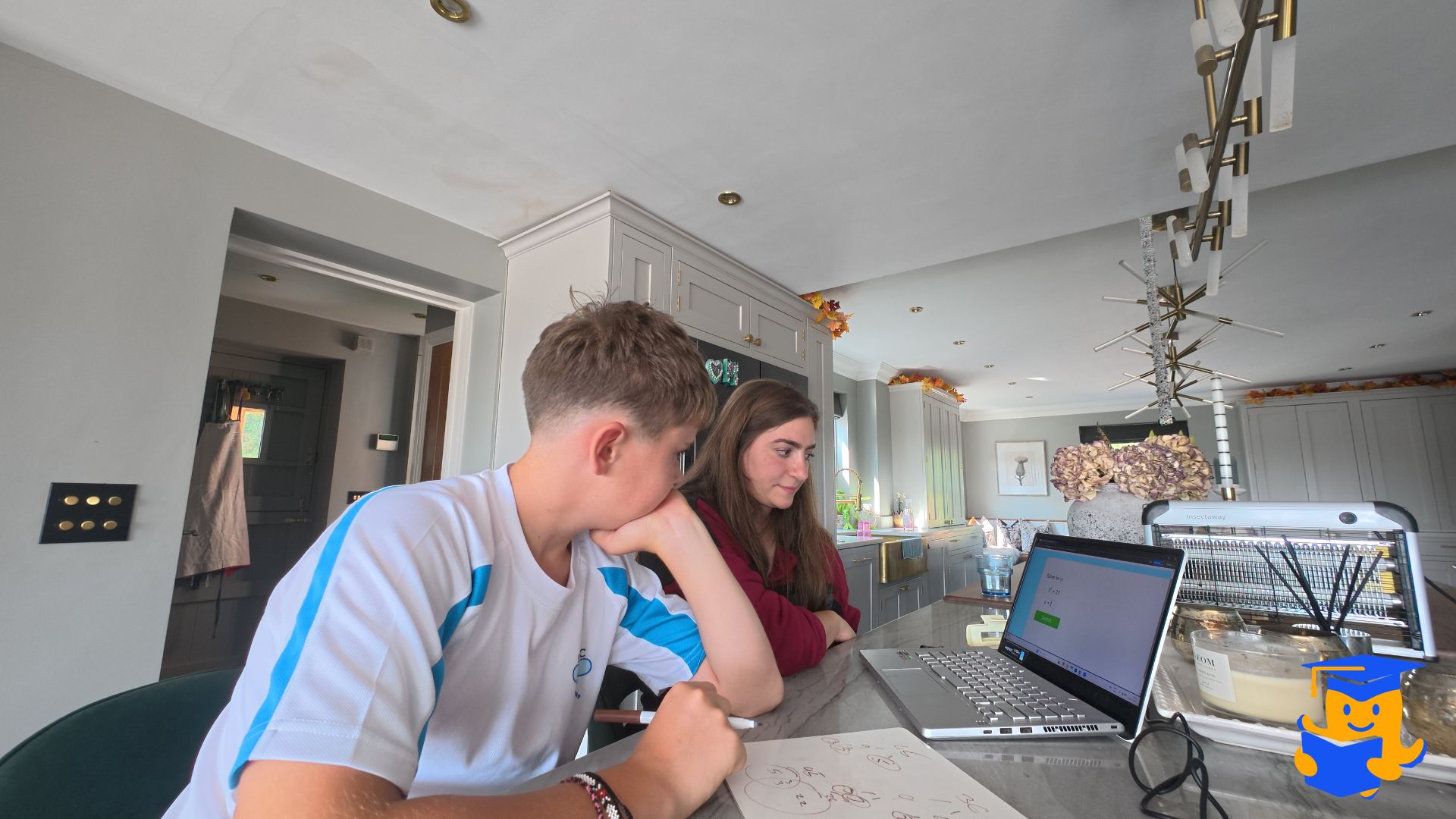
One-to-one GCSE maths tutoring delivers measurable results when delivered consistently and strategically. Here's what parents in Slough need to know.
Key Takeaways
- One-to-one tutoring produces approximately five additional months of learning progress, with 80% of students improving by up to three grades when receiving consistent support over 12 months.
- Maths knowledge gaps compound over time – a Year 10 student struggling with fractions may have foundational issues from Year 2, requiring diagnostic assessment to identify exact breakdown points.
- Weekly consistency outperforms cramming – students receiving regular weekly sessions across a full academic year achieve significantly better results than those cramming the same total hours before exams.
- Starting in Year 10 allows realistic improvement timeframes without last-minute panic, giving students room to build deep understanding rather than memorising short-term exam strategies.
- Qualified teachers with QTS bring essential expertise that general tutors lack, including exam board familiarity, differentiation skills, and evidence-based pedagogy for addressing learning barriers.
The difference between effective tutoring and wasted money comes down to three factors: starting early enough to allow proper skill-building, maintaining consistent weekly attendance with independent practice between sessions, and working with qualified teachers who use diagnostic assessment to target exact gaps rather than following generic lesson plans. The evidence is compelling for effective maths tuition Slough offers: one-to-one tutoring can deliver approximately five additional months of progress on average. Three in four students improve by up to three grades. We've seen how targeted support addresses the gaps that classroom teaching often misses, particularly for GCSE students facing tighter grade boundaries and mounting exam pressure. In this piece, we'll walk you through what makes one-to-one GCSE maths tuition Slough parents are choosing so effective. You'll learn what to look for in a qualified maths teacher in Slough and how consistent GCSE tutoring Slough students receive can raise grades faster than you might expect.
Why GCSE Maths Students in Slough Need Extra Support
Grade boundaries are getting tighter
The mathematics pass rate dropped to 71.8% in recent years. Nearly three in every ten 16-year-olds sitting their GCSE maths exam for the first time don't achieve a grade 4. Grade boundaries move by roughly ±7 marks each year depending on that particular paper's difficulty. Exam boards adjust these thresholds to maintain fairness, but students and parents face unpredictability. A student aiming for a grade 5 one year might need 180 marks, while the next cohort needs 187 for the same grade.
This system puts pressure on students who sit close to boundary lines. Schools face accountability for the percentage achieving grade 5 or above, the "strong pass" threshold. Students who don't reach a grade 4 must resit the exam during sixth form or college and dedicate three to four hours per week to the subject. Over a quarter of students sitting these exams didn't achieve a passing grade in 2024, a 5% increase since 2022. Resits rarely work out when foundational understanding hasn't been addressed.
Knowledge gaps build up over school years
Maths is ruthlessly cumulative. A child who doesn't grasp place value or times tables early on finds that every new concept sits on unstable ground. Analysis of learning data shows a 4-year gap has developed in many classrooms by upper primary, with several years of learning separating the highest and lowest attainers. The knowledge gap widens as students get older because mathematical knowledge builds strictly upon previous concepts.
The consequences cascade when your child reaches secondary school without secure foundations. Students resitting GCSEs often show weak understanding of fundamentals like place value, times tables and number bonds, even though some achieved a grade D previously. Arithmetic with negative numbers, order of operations, and relationships between fractions and decimals remain shaky. These aren't abstract deficiencies. They prevent students from accessing the algebra and geometry required at GCSE level.
The challenge for parents seeking GCSE tutoring Slough is identifying where these gaps sit. A Year 10 student struggling with equivalent fractions might have a problem rooted in Year 2 understanding of equal groups. Small gaps that appeared early inhibit students from understanding more advanced concepts that depend on them. Students keep hitting the same barriers without targeted intervention that traces concepts backward to find exact foundations.
Classroom teaching can't address individual weak spots
Teachers working with 30 students in a classroom have very limited time for one-to-one teaching. Every student has knowledge gaps that need attention at any moment, but the reality is that all students are expected to move through the curriculum at the same pace. The achievement gap increases under this model.
Students often ask questions that seem surface-level but point to deeper misunderstandings when they raise their hands in class. A busy teacher rushing between raised hands might offer quick fixes, yet the student feels satisfied temporarily and comes unstuck again almost right away. Students keep returning with different difficulties when teachers address superficial problems instead of root causes.
Research on students with mathematical learning difficulties shows that poor working memory and weak long-term memory for mathematical facts compound the problem. Classroom environments can't accommodate the varied cognitive needs present in every lesson. Some students need much longer in the concrete phase of learning to embed representations safely, but whole-class pacing doesn't allow for this.
Finding a qualified maths teacher in Slough who can work through diagnostic assessment to locate exact gaps makes the difference. Three-way differentiation, where students are labeled high, medium or low ability, doesn't address the reality that individual students have unique combinations of strengths and gaps. What appears to be 30 different problems in a classroom often boils down to two fundamental misunderstandings. One-to-one maths tuition Slough families choose gives space to identify and address those deeper issues.
What 1-to-1 Tutoring Actually Improves (vs Classroom Learning)
Personalised pacing matched to your child's level
Lessons can be tailored entirely to your child's needs with one-to-one tuition. Tutors adapt each session based on preferred learning style and adjust the pace to match understanding rather than rushing through a predetermined syllabus. Your child can revisit difficult topics as many times as needed when they work with a qualified maths teacher in Slough for GCSE tutoring. The tutor moves forward if they grasp a concept quickly. They slow down if not.
This responsive approach meets students at the point where understanding actually broke down, instead of just addressing their current grade level. A Year 10 student working at grade 3 doesn't benefit from grade 5 content. Personalised tutoring identifies the exact concept where comprehension faltered and builds from there. Progress sits on solid ground rather than being patched over. Research on one-to-one tutoring shows it supports richer personalisation, including greater responsiveness to students' academic needs.
The tutor can identify your child's Zone of Proximal Development and provide the framework to support learning within that range. Classroom teachers must keep 30 students moving through the curriculum at roughly the same speed, by contrast. The tutor slows down just enough to check whether they truly understand the ideas underneath the procedures when students are keeping up in one-to-one sessions, rather than simply memorising steps.
Targeted focus on weak topics
Effective maths tuition Slough parents choose starts with an individualised approach. The tutor carefully assesses needs and identifies the correct starting point. Early sessions use discussion, diagnostic questions and recent school work to identify where the chain of understanding is breaking. That might be a missing foundation topic, an algebraic weakness, calculator use, interpretation of wording or difficulty transferring a familiar method to a new context.
Support can concentrate on reliable arithmetic, fractions, percentages, ratio, algebra and other prerequisite skills that affect performance in several parts of the GCSE course. Tutoring focuses lessons on the exact gaps holding your child back. Recurring mistakes are recorded and revisited so practice targets the areas that actually limit performance rather than repeating questions they already handle well.
Lessons can change emphasis to unfamiliar contexts, proof, algebraic reasoning, multi-topic questions and explaining why a method works once core accuracy is secure. We use diagnostic assessment to find precise gaps before building a well-laid-out learning plan around those specific weaknesses at Aljabra.
Direct feedback without classroom pressure
One-to-one attention creates a safe, supportive environment where students can learn at their own pace. Your child has freedom to ask questions without fear of embarrassment with the tutor's full attention. Feedback is immediate, clear and encouraging. Misconceptions get corrected straight away. Classroom teachers may take time to review and return assignments, by contrast. Tutors correct errors, address doubts or clarify misunderstandings on the spot.
This immediate intervention reinforces correct understanding and supports long-term mastery of concepts. Research shows that one-to-one tutoring offers greater levels of interaction and feedback compared to whole class teaching, which supports pupils to overcome barriers to learning and increase progress through the curriculum. One-to-one tutoring provides approximately five additional months' progress on average.
A tutor creates a supportive environment where mistakes are seen as part of the learning process. Good tutors don't just correct mistakes; they help students understand that errors are a normal part of learning. A wrong answer becomes useful if your child understands why it went wrong. This mindset change reduces fear of failure and helps students approach challenges with greater resilience.
Building confidence through small wins
Small victories matter. Whether it's solving a difficult problem or finally understanding a topic, these moments gradually rebuild self-belief. Tutors help students recognise their progress and celebrate achievements with consistent support and positive reinforcement. Confidence increases as students gain better understanding, reducing anxiety and fear associated with maths.
Tutors provide encouragement that changes how students see their abilities. Simple affirmations make progress visible and keep motivation high. Many children become more willing to speak up, share ideas and take academic risks as trust grows between the tutor and student. One-to-one tutoring creates opportunities to experience success without removing the challenge that makes learning meaningful.
Confidence development tends to follow a natural progression. Students need to build trust and overcome fear of being judged at first. Tutors create a safe space where small achievements are celebrated and even mistakes are recognised as progress. Structured guidance introduces strategies such as breaking down large tasks into smaller steps once trust has been built. The tutor gradually reduces direct help as your child begins to internalise those approaches, allowing them to attempt problems more independently.
Choosing tutors in Slough who understand that building confidence takes time but produces lasting results means finding the right GCSE maths tuition Slough offers. Your child becomes able to take full ownership of their learning, planning their own study time and choosing revision methods that work best for them eventually.
How Much Can Grades Improve with 1-to-1 Maths Tuition
What the research says about grade improvements
The Education Endowment Foundation reviewed dozens of studies and found that one-to-one tuition produces approximately five additional months of learning progress compared with students who receive no tuition. The evidence is strongest for younger pupils and for those who are behind expected levels, which matches what we see in practice: a student with genuine content gaps benefits more from well-laid-out tutoring than one who just needs exam polish.
Recent research offers even more encouraging findings. Three in four students improve their performance by up to three grades with one-to-one tutoring. For maths, 80% of students who received tutoring for 12 months improved by up to three grades. This isn't about natural ability. The study confirmed that tutoring partnerships are more valuable when sustained over time: while just 44% of students who had taken fewer than 10 lessons improved their grades, 79% of those who had taken at least 36 lessons reported grade increases.
Independent outcomes data from various tutoring programs shows similar patterns. Students attending more than 12 hours of tutoring averaged a GCSE result 2.1 grades above predictions, while those attending more than 10 hours averaged an improvement of 0.5 grade. Consistent support across an extended period allows time for mock exams to check progress and address newly revealed gaps, accounting for inevitable disruptions from illness or school trips.
Typical timeframes for a one-grade jump
For a single grade improvement, most students working with a tutor see progress you can measure within one school term, roughly 10 to 12 weeks of weekly sessions. This timeframe assumes consistent attendance and some independent practice between sessions. A two-grade improvement needs closer to a full academic year.
Research identifies a minimum threshold: at least one hour of tutoring per week is required for any real impact. Sporadic sessions, even high-quality ones, don't compound the same way regular weekly sessions do. Ten focused weekly sessions with exam-based feedback will produce more grade improvement than thirty general revision sessions without a specific plan.
Our GCSE maths tuition Slough program at Aljabra structures sessions around this evidence. Weekly consistency matters more than cramming total hours before exams.
Why some students improve faster than others
Four factors most commonly explain why individual students need more or fewer hours than average measures suggest:
- Starting point relative to the grade boundary: A student sitting just below a grade boundary in recent mock exams needs fewer hours to cross it than one sitting well below, even if both target one grade of improvement
- Consistency: Weekly attendance with independent practice between sessions outperforms the same total hours delivered irregularly or in a late cramming burst
- Engagement and follow-through: A student who completes set homework and flags confusion between sessions allows tutors to diagnose and fix gaps faster than one who only engages during the session itself
- Subject responsiveness: Maths tends to respond to well-laid-out tutoring faster than extended-writing subjects, where quality grows through iterative feedback rather than discrete topic teaching
Maths is cumulative, so gaps in early topics cascade into difficulties with later content. Students with important maths gaps need more sessions than those with gaps in single-topic subjects.
What to Look for in a GCSE Maths Tutor in Slough
Qualified maths teachers vs general tutors
The label "tutor" carries no legal protection in the UK. Anyone can call themselves a tutor and charge for sessions, whatever their training or curriculum knowledge. This reality makes qualification checks necessary rather than optional. A qualified teacher holds Qualified Teacher Status (QTS), earned through rigorous Initial Teacher Training with hundreds of hours of supervised classroom teaching, academic study of pedagogy, evidence-based assessments and formal safeguarding training. They must also meet ongoing professional development requirements.
Qualified teachers understand what AQA, Edexcel and OCR examiners expect. They distinguish between a grade 5 answer and a grade 7 answer in ways that university students offering tutoring simply cannot. They possess differentiation skills honed from adapting delivery for varied learners and spotting hidden barriers like undiagnosed processing issues. Lesson pace adjusts instantly. Many tutors have strong subject knowledge but no formal teaching training, so they rely on personal intuition rather than evidence-based pedagogy.
Qualified teacher expertise makes a measurable difference for students with big gaps or learning difficulties. At Aljabra, our GCSE maths tutoring Slough program uses qualified teachers who bring classroom experience into personalised settings.
Familiarity with AQA, Edexcel and OCR exam boards
Each exam board structures questions differently and uses distinct mark scheme language. Grade boundaries vary too. A tutor teaching from the wrong board specification may cover untested content or miss required topics. Tutors must work from your child's actual exam board and use that board's past papers, mark schemes and examiner reports rather than generic materials.
Question-style familiarity matters. A tutor experienced with your child's specific board understands common pitfalls, expected terminology and how to structure answers for maximum marks. Always confirm your child's exam board before you hire any maths teacher in Slough for GCSE support.
Proven track record with GCSE students
Look for demonstrable history of results with the specific age group and exam level your child needs. Testimonials should mention grade improvements and confidence gains rather than vague praise. Reputable tutors in Slough provide evidence of student progress and welcome questions about their approach to assessing gaps and measuring improvement. Accountability matters.
Tailored learning plans, not generic worksheets
Diagnostic assessment identifies exact starting points. That's where tutoring should start. Then build structured plans around specific weaknesses rather than following generic programs. Sessions should adapt to your child's responses, not deliver predetermined content whatever their understanding.
Local in-person options or flexible online sessions
Both formats work when delivered consistently. Children who respond better face-to-face suit in-person tutoring. Online sessions remove travel time and scheduling friction. Use a laptop or tablet with stylus rather than a phone for online work. Quality matters more than location, but consistency matters most.
How Aljabra Approaches GCSE Maths Tutoring in Slough
1-to-1 sessions tailored to exam board and current grade
Our GCSE maths tutoring Slough program works from your child's actual exam board specification. We teach to AQA, Edexcel or OCR using the real papers and mark schemes their board sets, rather than adapting generic maths content after the fact. This difference matters. Exam boards structure questions differently and use distinct terminology. They expect specific answer formats. Our maths teacher in Slough understands these nuances and prepares your child for the exact exam they'll sit.
Sessions adjust to your child's current working grade. A student operating at grade 3 receives different focus than one sitting at grade 6, even when both target the same final grade. We match pacing to understanding rather than forcing predetermined lesson plans.
Diagnostic assessment to find exact gaps
Most tutoring fails because it starts with a lesson plan instead of understanding the student. We begin with a diagnostic process that reveals where knowledge chains actually broke. We then figure out how to build the full picture: sometimes through a short test, sometimes naturally in the first session, sometimes by reviewing recent past papers. Whatever fits your child best.
The goal isn't just finding wrong answers but understanding the thinking behind them. Once we know where gaps sit, we build a plan around those specific weaknesses.
Progress tracking and regular parent updates
We track progress and report on it honestly. You receive a brief update after each session. It covers what we worked on, how it went, and one thing to practice before next time. This takes two minutes but completely changes your experience as a parent: every payment has a visible result attached.
We provide periodic progress summaries every four to six weeks alongside these weekly notes. These show the arc: where your child was, where they are now, what comes next.
Ready to Help Your Child Get the Grade They Deserve? Visit our GCSE Maths page to learn more about how our maths tuition Slough approach works.
When to Start Tutoring for Maximum Impact
Starting in Year 10 vs last-minute Year 11
A student who begins structured, weekly tutoring in Year 10 or at the start of Year 11 has room to work through realistic improvement timeframes without the final months becoming a rushed sprint. Early starts allow your child to build understanding step by step, address gaps as they arise, and reach exam season already well-prepared. Students beginning in April of Year 11 operate in triage mode and focus on short-term strategies rather than deep skill-building. That said, students who begin even weeks before exams perform better than those receiving no support.
How many sessions are needed
We recommend 20 to 30 sessions throughout the academic year, weekly at first and twice weekly as exams approach. Students receiving consistent tutoring throughout the full GCSE course rather than just exam preparation achieve the most important improvements. At Aljabra, our maths tuition Slough program structures sessions around this evidence-based timeline.
Why consistent weekly sessions work better than cramming
The spacing effect, one of the most replicated findings in learning science, shows material studied in spaced sessions is retained far better than content crammed into short periods. One term of consistent weekly tutoring makes more difference than six months of sporadic sessions. So weekly attendance with independent practice between sessions outperforms irregular delivery.
Conclusion
One-to-one support works because it addresses the exact gaps holding your child back. They learn at their own pace without classroom pressure. The evidence shows that consistent tutoring delivers measurable results, especially when you start early and maintain weekly sessions rather than waiting until exam panic sets in.
The decision you make now shapes your child's options later. Ready to help your child get the grade they deserve? Our qualified maths teachers in Slough use diagnostic assessment to find precise gaps and then build structured plans around them. We track progress, report honestly and work from your child's actual exam board.
Visit our GCSE maths tutoring page to see how our approach works in practice.
FAQs
Q1. How much can my child's GCSE maths grade improve with one-to-one tutoring? Research shows that three in four students improve by up to three grades with one-to-one tutoring. For maths specifically, 80% of students who received tutoring for 12 months improved by up to three grades. On average, one-to-one tuition produces approximately five additional months of learning progress compared to students who receive no tuition.
Q2. When should I start GCSE maths tutoring for my child? Starting in Year 10 or at the beginning of Year 11 provides the best results, allowing time to address knowledge gaps progressively without last-minute cramming. Students who begin early can work through realistic improvement timeframes and reach exam season well-prepared. However, even students who start just weeks before exams consistently perform better than those receiving no support.
Q3. How many tutoring sessions does my child need to improve one grade? For a single grade improvement, most students see measurable progress within 10 to 12 weeks of weekly sessions. A two-grade improvement typically requires closer to a full academic year. Research shows that at least one hour of tutoring per week is required for meaningful impact, with 20 to 30 sessions across the academic year being the recommended amount.
Q4. What should I look for when choosing a GCSE maths tutor? Look for a qualified teacher with Qualified Teacher Status (QTS) who has specific experience with GCSE students and familiarity with your child's exam board (AQA, Edexcel, or OCR). The tutor should provide tailored learning plans based on diagnostic assessment rather than generic worksheets, and offer a proven track record with demonstrable grade improvements.
Q5. Why is one-to-one tutoring more effective than classroom learning for GCSE maths? One-to-one tutoring allows personalised pacing matched to your child's level, targeted focus on specific weak topics, and immediate feedback without classroom pressure. The tutor can identify exact knowledge gaps and address them systematically, while building confidence through small wins. This individualised approach addresses the reality that classroom teachers have limited time for one-to-one attention with 30 students.
References
GCSE results day 2026: maths top grades rise after grade boundaries lowered Edexcel Maths GCSE Grade Boundaries GCSE Grade Boundaries Qualified Teachers vs Tutoring Coaches: The Difference Knowledge Gap Retention The Knowledge Gap in Every Maths Classroom How to Identify Learning Gaps Best Online GCSE Maths Tutors UK 2026 How Many Hours of GCSE Tutoring One to One Tuition - EEF Teaching & Learning Toolkit Benefits of Personalized Math Tutoring AQA vs Edexcel vs OCR GCSE Guide 2026 EDS Maths Expertise Maths Tutoring Method: 4-Step Strategy How to Find a Good GCSE Tutor Ariston Education - Our Tutors Qualified Teacher vs Tutor: Which Is Better In-Person vs Online Maths Tutoring Online Tutoring vs In-Person Tutoring for GCSE How to Communicate with Parents as a Private Tutor How Many Hours of GCSE Tutoring to Raise a Grade Why Weekly Tutoring Works Better Than Cramming Grade Improvement, Exams & Tutoring Effectiveness Maths Exams: Where Are Students Falling Short? How to Support Pupils Who Struggle with Maths If It's Friday, It Must Be GCSE Re-sit Understanding Factors Behind Mathematics Block and Barriers to Learning Benefits of One-to-One Tutoring: Is It More Effective Than Classroom Learning? The Role of Tutoring in Building Confidence Benefits of Tutoring Why One-on-One Tutoring Works EdWorkingPaper AI25-1289 How Tutoring Builds Confidence GCSE Maths Tuition Improve GCSE Maths Grades in One Term How Tutoring Can Boost Confidence as Well as Grades Building Academic Confidence: Why Small Wins Matter New Study Proves One-to-One Tutoring Drives Significant Grade Improvement University's Maths Tutors Help GCSE Children Raise Results
Ready to help your child succeed?
Book a free trial session with one of our expert tutors in Slough, Windsor or online.
Book a Free Trial