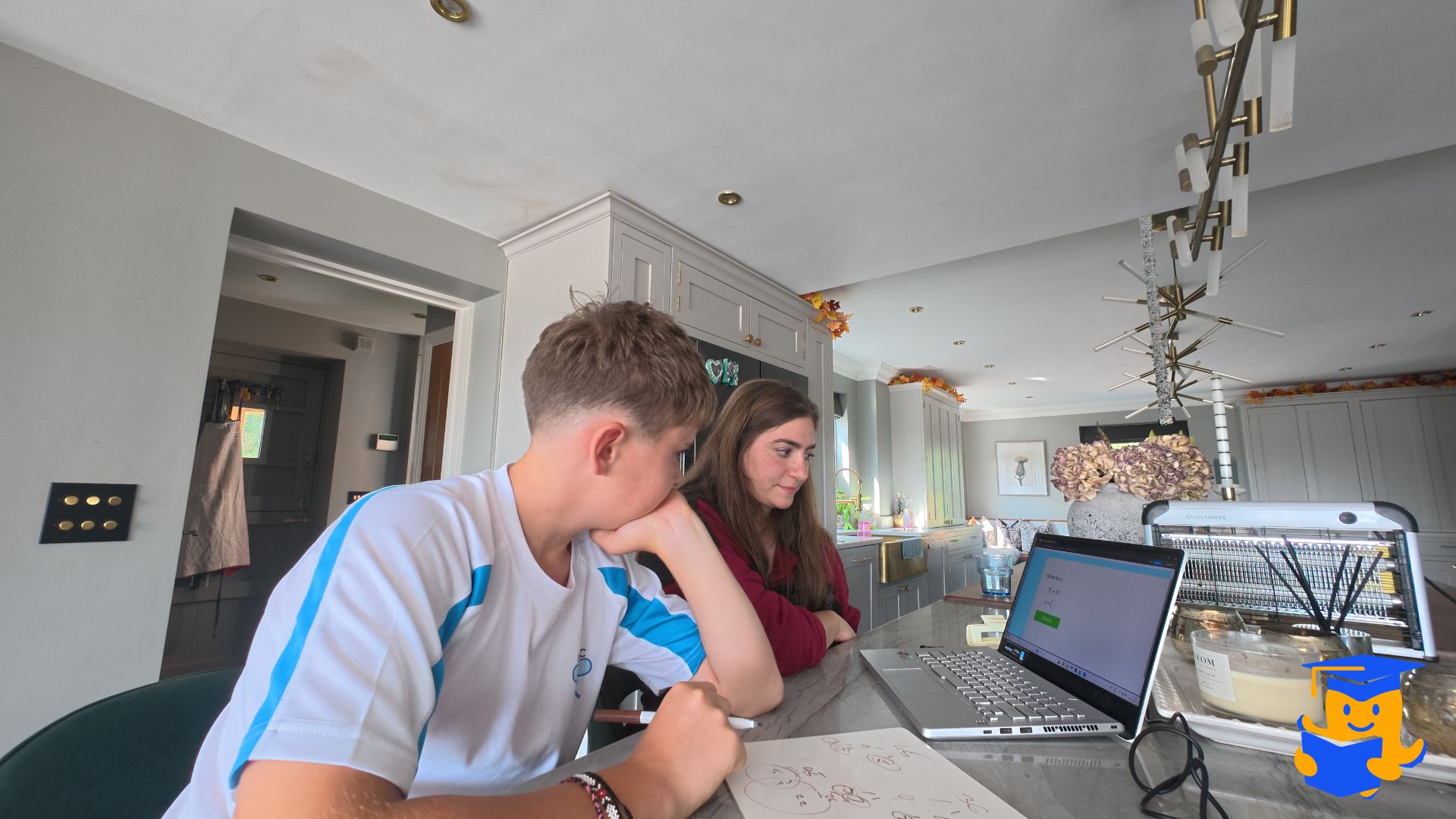
GCSE maths trips up more students than almost any other subject, not because the content is impossible, but because most people revise it the wrong way. Reading through notes, copying out formulas, and watching a few videos feels like revision, but it rarely translates into exam marks. The students who jump a grade or two in the run-up to their exams do something different: they practise the actual skill of answering exam questions, under something close to exam conditions, again and again, on exactly the topics they're weakest at.
This guide walks through exactly how to do that. It covers how the exam is structured, how to build a revision timetable that actually gets followed, how to break the syllabus down topic by topic, which techniques genuinely improve recall, and which free resources are worth your time. Whether you're starting revision six months out or six weeks out, everything below is written to be usable today.
Understanding the GCSE Maths Exam Before You Start Revising
You cannot revise effectively for an exam you don't understand the shape of. Before opening a textbook, it's worth spending twenty minutes getting clear on three things: your tier, your exam board, and the paper structure.
Foundation Tier vs Higher Tier
GCSE maths in England, Wales and Northern Ireland is split into two tiers.
- Foundation tier covers grades 1 to 5. It focuses more on number, basic algebra, ratio and straightforward geometry, with less emphasis on the most abstract topics.
- Higher tier covers grades 4 to 9. It includes everything in Foundation plus more advanced algebra, trigonometry, vectors, and more complex probability and statistics.
If you're not sure which tier you've been entered for, your school will know, and it matters because revising the wrong tier's content wastes time you don't have. Higher tier students still need to be rock solid on Foundation-level number and algebra skills, since those underpin almost every harder question.
Know Your Exam Board
The three main exam boards in England are AQA, Pearson Edexcel, and OCR. The content overlaps heavily, but the way topics are worded, the formula sheet provided, and the style of questions differ enough that revising from the wrong board's past papers can leave you underprepared for how your actual exam will ask things.
Check your exam board with your teacher, then go straight to that board's official specification page:
Each of these pages links to the actual specification document, which lists every topic you can be examined on. It's dry reading, but it's the single most accurate list of what you need to know, more accurate than any revision guide summary.
Paper Structure
Most GCSE maths exams are split across three papers: one non-calculator and two calculator papers, each roughly 1.5 hours long, together making up the full grade. Marks are weighted across Number, Algebra, Ratio and Proportion, Geometry and Measures, and Statistics and Probability, with Algebra and Number typically carrying the most marks between them. That weighting matters when you're deciding where to spend limited revision time. Being excellent at probability trees but weak at solving equations is a worse position than being solid at both, because algebra appears far more often.
Common Revision Myths That Waste Time
Before getting into the plan itself, it's worth clearing up a few widely believed ideas about revision that don't hold up well once you look at how memory and skill actually work.
Myth: rewriting notes neatly counts as revision. Copying out notes, even into colour-coded, beautifully formatted pages, mostly tests handwriting and organisation, not maths ability. It feels productive because it's low-effort and visually satisfying, but the actual cognitive work of retrieving a method from memory and applying it never happens. If notes need reorganising for clarity, that's a one-off task, not a repeatable revision technique.
Myth: highlighting textbooks helps you remember content. Highlighting creates an illusion of engagement. The eyes move across the text and a colour gets added, but nothing is being recalled or tested. Research on study techniques consistently ranks highlighting among the least effective methods for durable learning, well behind active recall and practice testing.
Myth: watching more videos is the same as practising. Videos are useful for learning or re-learning a method for the first time, but watching a worked example is fundamentally different from doing one yourself. Many students mistake "I understood the video" for "I can do this," and only discover the gap when a past paper question doesn't look quite like the video's example.
Myth: longer sessions are always better. Focus drops off sharply after 30 to 45 minutes for most people. A three-hour unbroken revision block usually contains less real learning than three separate 40-minute sessions with breaks, because attention and working memory both degrade with fatigue.
Myth: you either "get" maths or you don't. GCSE maths content is almost entirely procedural and learnable through practice. Genuine, fixed mathematical ability plays a much smaller role than consistent, well-structured practice, particularly at GCSE level where the content is designed to be accessible with the right preparation.
Step 1: Build a Revision Timetable You'll Actually Follow
Almost everyone makes a revision timetable. Almost nobody sticks to one. The usual mistake is building a timetable that assumes a version of yourself with more time, energy and discipline than you actually have.
A timetable that works has a few features:
- It's built around your real week, including school, clubs, sleep and downtime, not an idealised version of it.
- It uses short, focused sessions. 25 to 40 minutes of focused work with a real break beats a vague "revise maths for two hours" block that turns into 20 minutes of actual work.
- It rotates topics rather than blocking single subjects for days at a time. Spacing out your practice of a topic over several sessions, spread across weeks, produces far better long-term recall than cramming one topic for a whole afternoon and never returning to it. This is often called spaced repetition, and it's one of the most well-evidenced techniques in learning science.
- It's weighted toward weaknesses, not comfort topics. It's tempting to revise the topics you already find easy because it feels productive. The marks gained from turning a weak topic into an average one are usually greater than the marks gained from turning a strong topic into a perfect one.
A simple way to structure this: list every topic on the specification, rate yourself honestly from 1 (no idea) to 5 (confident), and build your timetable so red and orange topics appear two to three times more often than green ones.
If you want a starting structure, a 6-week plan might look like:
- Weeks 1 to 2: Number and Algebra basics (the foundation for everything else)
- Weeks 3 to 4: Ratio, Proportion, Geometry and Measures
- Week 5: Statistics, Probability, and any remaining weak topics
- Week 6: Full past papers under timed conditions, reviewed and corrected
Adjust the balance depending on your tier and which topics your mock exams flagged as weak.
A Sample Weekly Structure
To make this concrete, here's what one week inside that plan might look like for someone revising after school, using short focused sessions rather than long blocks:
| Day | Session 1 | Session 2 |
|---|---|---|
| Monday | 30 min: solving linear equations (self-test) | 20 min: Corbettmaths 5-a-day, mixed |
| Tuesday | 30 min: factorising quadratics | Rest |
| Wednesday | 30 min: percentage change word problems | 20 min: redo Monday's mistakes |
| Thursday | 40 min: timed mini past-paper section | Rest |
| Friday | Rest or light review | 20 min: flashcards on formulae |
| Saturday | 45 min: full past paper section, marked properly | Rest |
| Sunday | 30 min: review the week's mistake log | Rest |
This isn't a rigid template to copy exactly, it's an illustration of the pattern that tends to work: short sessions, built-in rest, topics revisited rather than done once and abandoned, and at least one proper past-paper session most weeks. Swap the specific topics for whatever your own weak areas are.
Building In Rest Without Guilt
A timetable with no rest days tends to fail within two weeks, either through burnout or through quiet abandonment once life gets busy. Treating rest days as a planned, deliberate part of the schedule, rather than something that happens by accident when discipline slips, makes the whole plan more sustainable. A revision timetable followed consistently at 80% intensity for six weeks will outperform one attempted at 150% intensity that collapses after ten days.
Step 2: Break the Syllabus Down by Topic
GCSE maths content splits into five broad areas. Understanding what sits inside each one helps you revise with a checklist mindset instead of a vague sense of "doing some maths."
Number
This underpins nearly everything else. Fractions, decimals and percentages, standard form, indices and surds (Higher), factors, multiples and primes, rounding and estimation, and basic arithmetic fluency without a calculator. Weakness here shows up as slow, error-prone working in every other topic, so it's worth getting genuinely fast and accurate at this before moving on.
Algebra
Usually the highest-weighted single area on the paper. Solving linear and quadratic equations, simultaneous equations, expanding and factorising, sequences, inequalities, graphs (straight line, quadratic, and for Higher, exponential and trigonometric graphs), and functions. Algebra rewards practice more than almost any other topic, because the skills are procedural: once you've solved twenty quadratic equations correctly, the twenty-first rarely surprises you.
Ratio, Proportion and Rates of Change
Ratio and proportion problems, percentage change, compound interest and growth/decay, speed-distance-time and other rate problems, direct and inverse proportion. These questions are often "wordy," meaning the maths itself is simple but working out what the question is actually asking is the hard part. Practising translating word problems into equations is the specific skill to drill here.
Geometry and Measures
Angles, area and perimeter, volume and surface area, Pythagoras' theorem, trigonometry (SOHCAHTOA and, for Higher, the sine and cosine rules), transformations, similarity and congruence, vectors (Higher). Diagrams in this section are rarely drawn to scale, so relying on "it looks like a right angle" instead of proving it mathematically is a common way marks are lost.
Statistics and Probability
Averages and spread (mean, median, mode, range, quartiles), representing data (histograms, cumulative frequency, box plots, scatter graphs), probability including tree diagrams and Venn diagrams, sampling methods. This section is often under-revised because it feels intuitive, but exam questions frequently test specific technical language ("mutually exclusive," "independent events") that costs marks if misused.
Step 3: Use Techniques That Actually Improve Recall
Not all revision activities are equally effective. Cognitive science research on learning consistently points to a small number of techniques that outperform passive review, and GCSE maths is a subject where they apply especially well because the skill being tested is doing, not just knowing.
Active Recall Over Passive Reading
Reading a worked example and nodding along feels like understanding, but it's a weak test of whether you could reproduce that method under exam pressure. Active recall means closing the book and attempting the question yourself first, then checking. It's uncomfortable because you get things wrong more often, but that discomfort is exactly what builds durable memory. The Education Endowment Foundation, which reviews evidence on teaching and learning methods, consistently ranks retrieval-based approaches among the most effective for long-term learning; see their Teaching and Learning Toolkit for the underlying evidence.
Spaced Practice
Revisiting a topic multiple times with gaps in between, rather than one long session, leads to better retention weeks later. This is why the topic-rotation timetable in Step 1 matters more than it might seem. A single three-hour session on quadratics the night before the exam is far less effective than six thirty-minute sessions spread across three weeks.
Interleaving
Mixing topics within a single practice session, rather than doing twenty near-identical questions in a row, forces you to first identify what type of problem you're looking at before solving it, which is exactly the skill a real exam demands. A mixed past paper does this naturally; a topic-specific worksheet doesn't.
Worked Example, Then Self-Test
For a new or shaky topic, look at one fully worked example, then immediately attempt a similar question without looking. Check it. Attempt another. This "watch one, do one, check one" loop builds procedural fluency faster than watching several examples in a row before attempting anything.
Teach It Out Loud
Explaining a method to someone else, or even to an empty room, exposes gaps in understanding that silent review hides. If you can't explain why you flip the inequality sign when multiplying by a negative number, you don't fully understand it yet, even if you can usually get the answer right.
Step 4: Past Papers Are the Single Best Revision Tool
If you do nothing else from this guide, do this. Past papers are the closest thing to a direct simulation of the actual exam, and they reveal exactly where marks are being lost, which is more useful than any amount of general topic review.
Where to Find Them
- AQA past papers
- Pearson Edexcel past papers
- OCR past papers
- Corbettmaths for topic-by-topic practice questions and worked video solutions
- Maths Genie for past papers, revision cards and topic-organised question sets
- Save My Exams for revision notes and exam-style questions with detailed answers
How to Use Them Properly
Running through a past paper only helps if you use it the right way. A few rules make the difference between a paper that teaches you something and one that just confirms what you already knew:
- Do it under real time pressure first, no notes, no calculator on non-calculator papers, phone away. This is the only way to find out how you actually perform under the conditions of the real exam, including the effect of time pressure on careless mistakes.
- Mark it against the official mark scheme, not just the final answer. GCSE maths gives method marks. Understanding exactly where marks are awarded within a working-out process teaches you how to structure answers to maximise partial credit even when you don't reach the final answer.
- Redo every question you got wrong, from scratch, a few days later, without looking at your previous attempt or the mark scheme first. If you can't do it unaided the second time, you haven't actually learned the method yet, you've just seen it.
- Keep a running list of "silly mistakes," things like sign errors, forgetting units, misreading the question, rounding too early. These aren't knowledge gaps, they're habits, and naming them specifically makes you more likely to catch yourself doing it next time.
- Do papers from more than one exam board once you're confident, since the core content overlaps and it stops you from unconsciously memorising question patterns rather than genuinely understanding the maths.
Step 5: Fix the Habits That Quietly Cost Marks
A significant chunk of lost GCSE maths marks has nothing to do with not knowing the maths. It comes from a handful of repeated, fixable habits.
Not Showing Working
Even when the final answer is right, many questions award most of their marks for method. Skipping steps to save time on an easy question is fine; skipping steps on a harder one that you get wrong means you score zero instead of two or three method marks. As a general rule, if a question is worth more than one mark, write down every step.
Rounding Too Early
Rounding a value in the middle of a multi-step calculation, then continuing to work with the rounded figure, compounds error and can push a final answer outside the accepted range. The general rule is to only round the very final answer, and to carry extra decimal places (or exact fractions and surds where relevant) through the working.
Misreading the Question
"Find the value of x" and "find the value of 2x" are different questions with the same setup. Underlining or circling exactly what's being asked before starting the working out catches this before it costs a mark, not after.
Forgetting Units
A correct numerical answer without the correct unit, or with the wrong unit, frequently loses a mark on measurement and geometry questions. Get in the habit of writing the unit as part of the final answer every single time, even in practice, so it becomes automatic.
Not Checking for "Does This Answer Make Sense"
A calculated length of negative 4cm, or a probability of 1.3, is a signal that a mistake happened somewhere in the working, and it's often quicker to notice this and go back than to keep going. Building in ten seconds of "does this answer look sensible" at the end of every question catches a surprising number of errors.
Step 6: Exam Technique for the Day Itself
Revision gets you the knowledge. Technique determines how much of that knowledge actually makes it onto the page under time pressure.
- Read the whole paper's structure first if time allows, noting mark allocations, so you can judge how much time and working each question deserves.
- Answer questions in the order that suits you, not necessarily the order they're printed in. If question 14 looks hard and question 18 looks easy, there's no rule against doing 18 first. Getting easy marks banked early builds confidence and avoids losing time getting stuck early in the paper.
- Don't leave a blank answer, ever. Even a partially worked, incorrect method can pick up a method mark. On multiple choice questions, an educated guess costs nothing and might be right.
- Watch the clock but don't panic-check it. Roughly one mark should take about one minute, so a six-mark question that's taking fifteen minutes is a sign to write down your best attempt and move on, returning later if time allows.
- Leave the last five minutes to check, not to start something new. Checking arithmetic, units, and whether every question has an answer written down is a better use of the final few minutes than starting a question you haven't attempted yet.
Revision Differences: Foundation Tier vs Higher Tier
The core techniques above (past papers, spaced practice, active recall) apply to both tiers, but where you focus matters differently.
For Foundation tier, the biggest wins usually come from complete fluency and speed on non-calculator arithmetic, fractions, percentages and basic algebra, since these appear repeatedly across all three papers and are the foundation for every wordier problem. Chasing the hardest possible topics is less valuable than making sure nothing in the "should definitely get this right" category is ever missed.
For Higher tier, the biggest wins usually come from the topics that separate grades 4 to 6 from grades 7 to 9: quadratic and simultaneous equations, trigonometry including the sine and cosine rules, algebraic proof, and multi-step problem-solving questions that combine two or three topics into one longer question. These longer, combined questions are specifically designed to be difficult to plan for unless you've practised recognising which sub-skills a question is drawing on.
Revising in a Group vs Revising Alone
Both have a place, but they suit different tasks. Group revision tends to work well for explaining methods to each other, quizzing each other on formulae, and working through a tricky problem together where a fresh perspective helps unstick a stuck approach. It tends to work badly as a substitute for individual timed past-paper practice, since a group setting rarely replicates the silence and pressure of a real exam, and it's easy for one confident student to end up doing most of the talking while others passively absorb rather than actively practise.
A reasonable split is to do the bulk of past-paper practice and self-testing alone, since that's where the real skill-building happens, and to use group sessions specifically for explaining methods aloud to each other or working through a small number of harder questions together. Treat a study group as a supplement to a solid individual routine, not a replacement for one.
What to Do in the Final Week Before the Exam
The final week isn't the time to start new topics from scratch. It's the time to consolidate, and to manage the practical and psychological side of exam prep.
- Do at least one full timed past paper, ideally at the same time of day as your actual exam, to get your body and brain used to performing at that time.
- Revisit your "silly mistakes" list from earlier past papers and check whether you're still making the same ones.
- Sleep properly. The evidence on sleep and memory consolidation is strong; an all-nighter of cramming reliably performs worse than a shorter revision session followed by proper sleep. The NHS has straightforward guidance on sleep and teenagers if this is an area worth improving in the run-up to exams.
- Prepare practical things the night before: calculator with fresh batteries, ruler, protractor, compasses, pens and pencils, and know exactly what time and where you need to be.
- Do a light, confidence-building review the morning of the exam, not a new topic. A quick look through key formulae or your silly-mistakes list is enough. Cramming something new an hour before the exam rarely helps and often just raises anxiety.
How Parents Can Help Without Taking Over
Parents and carers often want to help but aren't sure what's useful versus what adds pressure. A few things reliably help without turning into nagging:
- Ask about specific topics rather than general progress. "How did the quadratics practice go today" invites a more useful answer than "have you done your revision," and signals genuine interest in the content rather than just checking a box.
- Help protect revision time from interruption, rather than supervising the content itself, especially once a student is past Year 10. Quiet, uninterrupted blocks of 30 to 45 minutes are more valuable than a parent checking every answer.
- Test recall out loud if asked. Reading out a question and letting a student explain the method verbally is a genuinely effective form of active recall, and doesn't require any maths knowledge from the parent, just the question and the mark scheme.
- Keep an eye on sleep, food and screen time in the final few weeks, since these have a bigger effect on exam performance than most people expect, and are easier for a parent to influence than the content itself.
- Avoid comparing progress to siblings or classmates. Comparative pressure reliably increases anxiety without improving the actual quality of revision.
If a private tutor is being considered, the most useful role for a tutor in the final months is usually diagnostic: identifying specific gaps from past-paper performance and drilling those, rather than re-teaching the whole syllabus from scratch, which is rarely necessary or an efficient use of remaining time.
Managing Maths Anxiety
Maths anxiety is common and well documented, and it can suppress performance independently of actual ability, meaning a student who understands the content can still underperform because of stress in the moment. A few things genuinely help:
- Familiarity through repeated past-paper practice reduces the unknown, which is a large part of what drives exam anxiety.
- Slow, deliberate breathing for 30 seconds if you freeze on a question is a legitimate technique, not just a platitude; it counters the physiological stress response enough to let you think clearly again.
- Reframing a blank moment as "skip and come back" rather than "I've failed" keeps the rest of the paper accessible instead of losing time to panic on one question.
If maths anxiety is a persistent, serious problem rather than ordinary exam nerves, it's worth talking to a teacher or, if it's affecting wellbeing more broadly, a GP or school counsellor, since this goes beyond what revision technique alone can fix.
Free Resources Worth Using
A short, curated list is more useful than a long, overwhelming one. These are consistently recommended by teachers and consistently used by students who improve their grades:
- BBC Bitesize for concise topic explanations and short quizzes, best used for a quick refresher rather than deep practice.
- Corbettmaths for topic-by-topic worksheets, video explanations, and the well-known "5-a-day" mixed questions for daily practice.
- Maths Genie for organised past papers and topic tests with full worked solutions.
- Save My Exams for revision notes written specifically around exam board specifications.
- Ofqual, the exams regulator, for official information on grading, exam changes and appeals if something goes wrong with results.
Tools Worth Having Before You Start
A short, practical checklist of what's genuinely useful to have on hand during revision, separate from the resources listed above:
- The exact calculator model allowed in your exam, practised with well before the exam itself. Scientific calculators vary in button layout between brands, and losing time hunting for a fraction or standard form button under exam pressure is an avoidable problem.
- The official formula sheet for your exam board, since not every formula is given, and knowing exactly which ones you're expected to memorise versus which will be provided prevents wasted effort learning something that's handed to you on the day.
- A physical mistake log, whether a notebook or a simple document, specifically for recording careless errors from past-paper practice, as covered earlier. This single habit tends to produce a noticeable, measurable improvement over a few weeks.
- A printed or saved copy of the specification for your exam board and tier, used as a checklist to tick off topics as they reach a confident standard, rather than relying on memory for what's been covered.
Frequently Asked Questions
How many hours a week should I revise GCSE maths? There's no single correct number, but consistency beats intensity. Several short, focused sessions spread across the week, each with real breaks, produce better results than one long weekend cram session. Three to five sessions of 30 to 45 minutes a week, increasing closer to the exam, is a reasonable general target.
What's the fastest way to improve a weak GCSE maths grade? Identify the two or three topics costing the most marks using a recent mock or past paper, drill those specifically using worked examples followed by self-testing, then return to full past papers to check the improvement is holding under exam conditions. Chasing broad, unfocused revision is slower than targeting known weak points.
Should I revise from a textbook or from past papers? Both have a role, but past papers should dominate. A textbook or revision guide is useful for first learning or re-learning a method; past papers are what actually train you to apply that method under exam conditions, which is the skill being tested.
Is it worth revising topics I already find easy? Only lightly, as maintenance rather than a priority. The marginal mark gained from perfecting an already-strong topic is usually smaller than the marks available from improving a weak one, so time is better spent on genuine weaknesses.
How do I stop making careless mistakes in exams? Keep a written log of every careless mistake made in past paper practice (sign errors, misread questions, early rounding, missing units) and review it before each subsequent practice paper. Naming the specific habit makes it far easier to catch in the moment than a vague intention to "be more careful."
Can I still improve my grade in the last month before the exam? Yes, meaningfully, though the strategy shifts. A month out isn't the time to try covering the whole syllabus from a standing start; it's the time to identify the handful of highest-value gaps (usually in Algebra and Number, since they carry the most marks) and drill those hard using worked examples, self-testing and past-paper questions, while doing at least one full past paper a week to check the improvement holds under timed conditions.
Does using a calculator on the calculator papers mean less need to know methods by hand? No. Calculator papers still test the same methods, the calculator just removes some of the arithmetic burden. Questions frequently require setting up an equation, choosing the right method, or interpreting a result, none of which the calculator does for you. Non-calculator arithmetic fluency also directly supports speed and confidence on the calculator papers, since less mental effort is spent on basic number work.
How useful are revision apps and flashcard tools compared to past papers? Flashcard-style tools are genuinely useful for memorising specific facts, like circle theorem names, formulae not given on the exam's formula sheet, or key statistical vocabulary. They're less useful for the multi-step problem-solving that makes up most of the marks on a GCSE maths paper, which is why they work best as a supplement to past-paper practice, not a replacement for it.
What should I do if I completely freeze on a question in the exam? Write down anything relevant, even a partial method, a diagram, or a formula that seems related, since method marks can still be awarded. Then move on to another question and come back at the end if time allows. Panicking over one question for ten minutes typically costs far more marks than skipping it and returning later with a calmer head.
Final Thoughts
GCSE maths revision that works isn't about the number of hours logged, it's about the quality of what happens inside those hours. Know your tier and exam board, build a timetable around your real life rather than an idealised one, spend the most time on your weakest topics, and treat past papers as the core of your revision rather than an afterthought at the end. Combine that with fixing the small habits that quietly cost marks, and steady, measurable improvement is realistic, even in a relatively short run-up to the exam.
Ready to help your child succeed?
Book a free trial session with one of our expert tutors in Slough, Windsor or online.
Book a Free Trial